

Improve decision-making with detailed approach to material inventory tracking
Snow Business archive
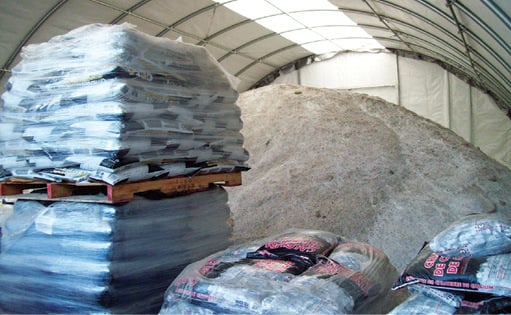
Use material accounting for better decisions
Salt accounting is the process of measuring and tracking ice control chemicals purchased and used during a season. The salt accounting system produces data that informs your decision-making as it relates to operations, sales and expenses.
More simply, salt accounting is a check register for your ice control chemicals. You make deposits (credits) when you take a delivery of material and withdrawals (debits) when you use material to service your sites.
At a minimum, your salt accounting system should tell you how much material you have purchased and when you used it. This system can be improved if you record where the salt is used by having salt truck drivers collect data for each site they service.
The scope or sophistication of your salt accounting system will depend on your needs, which in large part is driven by the size of your business. It’s important to collect the same basic data whether you use 10 or 10,000 tons a season. The more ice control chemical you use the more savings of alarger whole number will mean more dollars for the bottom line.
The benefits of measuring
Measuring and managing your ice control chemicals has multiple benefits. If you effectively track the flow of material through your business by event, driver and property serviced, you will have important data that can provide insights into developing and improving best practices. Feedback from your system will help to increase or improve:
Production efficiency. Feedback to drivers about proper application rates and methods reduces waste and guesswork and improves their effectiveness, resulting in more efficient service.
Storm management. Reduced consumption increases salt truckload range, which improves routing, reduces drive time for reloading andincreases service consistency. Improved material management and awareness will reduce mistakes and the possibility of running out of material at critical times.
Cost control. Reduce costs by using what is necessary, avoiding waste and reducing overall material consumption, which reduces inventory and related carrying costs.
Inventory management. Determine how much product is necessary to service your client base for the season so you can accurately order in the preseason and manage in-season inventory levels.
Client expectations. With increased attention to detail, you are more likely to meet or exceed client expectations due to consistent and improved performance by avoiding under- or over-application.
Legal defense. Tracking material use at the client level provides useful information to dispute slip-fall claims.
Confidence. Crew members will have increased confidence in their work because they understand what they are doing and the accounting process will become second nature. You’ll be able to compare variables and measure outcomes as you experiment and test products and equipment, leading to operational tweaks in search of the sweet spot, resulting in the definition of your company’s best practices. If you don’t measure, you won’t be certain that one change or variable is better than another.
What salt accounting info to collect
While your salt accounting system doesn't need to be fancy, it should collect at least this essential information:
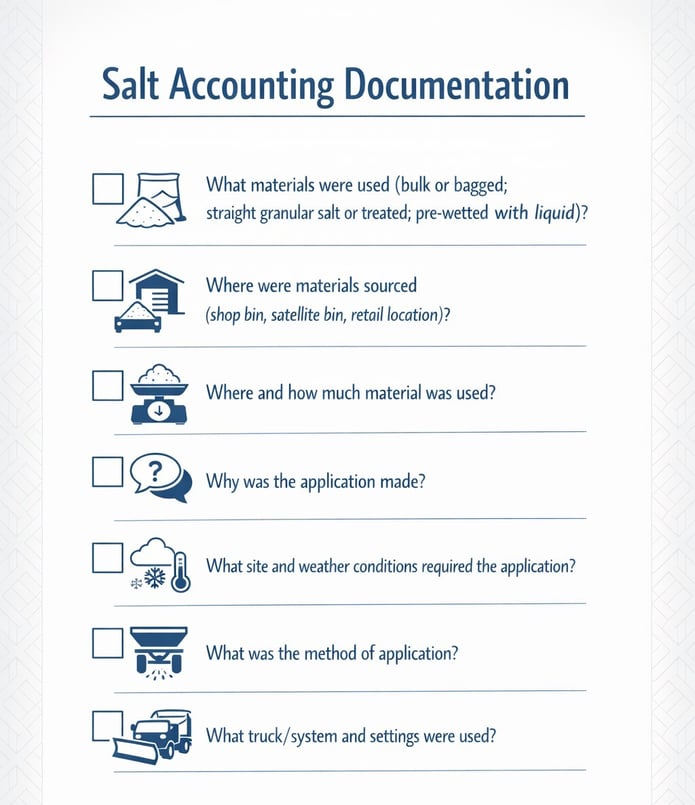
Keep a separate inventory register for each product that you use and for each location where product is stored. Physically checking inventory periodically will help uncover discrepancies, which can be investigated and rectified in a timely manner.
Excerpted from a Snow Business magazine story written by Doug Freer, CSP, of Blue Moose Snow in Cleveland, OH.
Related Articles

Strategies for stretching your salt supply
Ice Management
Salt availability is scarce and prices are through the roof—what’s your contingency plan?
Effective strategies for storing deicing liquids
Ice Management
Factors to consider when planning for liquid materials storage.

Maximizing ROI with liquids
Ice Management
Initial liquids costs are high but long-term benefits can be substantial.