

Josh Howver, ASM
Ensure liquids equipment has a long life
Liquid deicers have become much more prevalent in the snow removal industry. There are lots of options for brine production, storage and application equipment. No matter which option you choose, you want to make sure that your equipment has a long-lasting life.
Tanks reduce corrosion
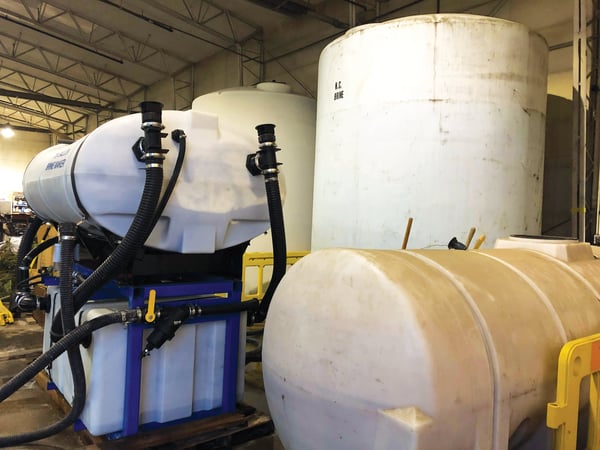
Liquid deicers hold an advantage in longevity over traditional deicing products because they are better contained and lead to less corrosion on the application equipment. Instead of granular salt sitting in a salter or the bed of a dump truck, liquids are stored in a unit purpose-built to withstand the liquids. There is no more salt sitting in the crevices of the truck bed leading to rust on your equipment. The same concept holds true for liquid storage at your yard or client properties. Storing liquids in polyethylene tanks or totes and transferring by camlock hoses to the application equipment eliminates salt sitting on the ground.
Onsite storage
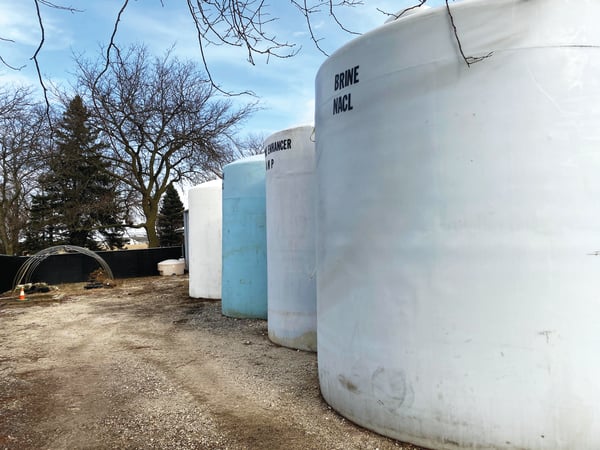
Even with a more professional covered bin, salt will still escape. The salt runoff can be unsightly to a client’s site as well as an environmental concern to local waterways. Clients might not be used to seeing a poly tank or tote sitting on their property, and it can cause concern with visitors. It’s a good idea to make sure your storage tanks are labeled with the chemical inside. This is a good practice for any storage tanks that you have, including at your own shop.
Postseason transport
As we approach the end of each season (which is almost always a guessing game), we try to use as much of our onsite supply as possible to avoid having to transport it back to our shop. Inevitably, we have to bring some back, but planning ahead can save time down the road.
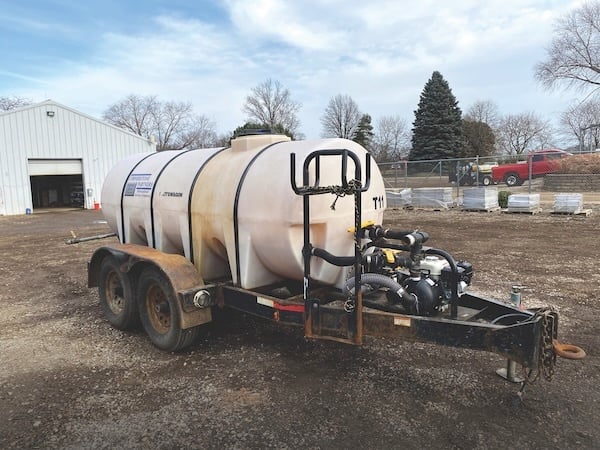
Our spray rigs have pumps that allow us to pump out or into the trucks, so we use our 300- and 500-gallon rigs to transport liquid back to the shop. We also use a 1,000-gallon water tanker, which has its own pump, to transport larger loads. If you don’t have pumps with suction capabilities on your trucks or tankers, use a water pump or trash pump to transfer the liquids from the storage tanks to your transport tank.
Offseason storage
Once they’re back to the yard, we store our liquids in designated bulk tanks year-round. One of the keys to storing salt brine is to ensure that it’s kept at a 23.3% NaCl (sodium chloride) solution. You can check this by using a salinometer, which can be purchased in electronic and manual versions. Upon verification that your brine is at 23.3% solution, you can rest easy knowing that your brine will not fall out of solution over the summer.
Our brine-enhancing additives are stored in separate tanks to avoid fallout. We mix our additives as they go into the truck tanks based on the type of storm we are trying to deice. This allows us to avoid being stuck with a mixed solution in trucks or in our onsite storage that could fall out of solution and clog the spray systems.
Cleaning equipment
With our liquids back in our shop’s tanks, we can now safely transport our onsite storage tanks back to the shop for cleaning. Cleaning tanks and spraying equipment is a simple task, but one that can be easily put on the back burner or forgotten altogether. It is vital to the longevity of the equipment that it gets cleaned as soon as it arrives back in the yard at the end of the season.
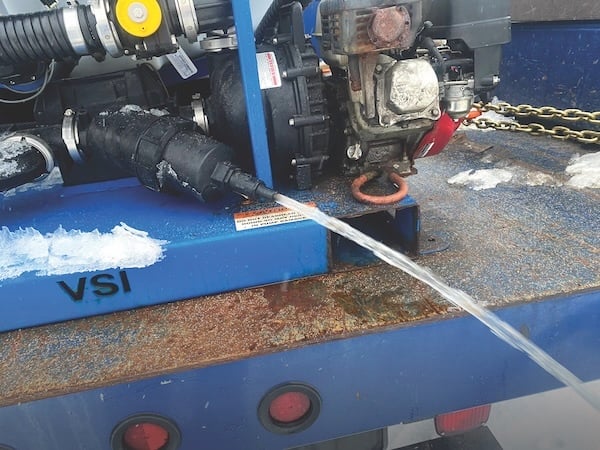
We rinse the insides of the tanks and spray rigs with water and dish soap. This allows us to know we don’t have any salt solution that could eat away at gaskets, seals, pump components, hoses and spray tips, electrical components or motors. If not cleaned out, the salt solution evaporates over the summer, leaving behind the abrasive salt that can actually seep through many of the seals that water normally wouldn’t be able to escape from.
Pumps, hoses and valves
Salt can cause issues for your pump since it will be highly abrasive to the impeller when it gets used next season.
-
First, agitate the soapy water in the tanks by recirculating it via the pump and hoses that only run through the tank.
-
Once you’ve recirculated it for about five minutes, open the valves to the spray booms or tips and allow the soapy water to run through all of your hoses and plumbing to clean out the valves.
-
Now that the tanks and plumbing are almost empty, open up any filters on the spray rigs. Turn off the pump and open up the valve on the filter. The soapy water will flow out.
-
Opening up the drain plugs on the pump body allows air in to flush out the pump, and the remaining water will exit through the filter.
-
Once the water has stopped draining, open up the filter and wash it out. The filter should have any of the debris that may have gotten into the tank during the season. Cleaning out the filter should be done during the winter season, as well, to check on how much debris is in the filter. You can also check the filter if you’re experiencing low pressure to your boom or spray tips since it may be clogged.
Winterize connections and motor
With the tank, valve, hoses and spray components cleaned out, move on to the electrical connections and motor.
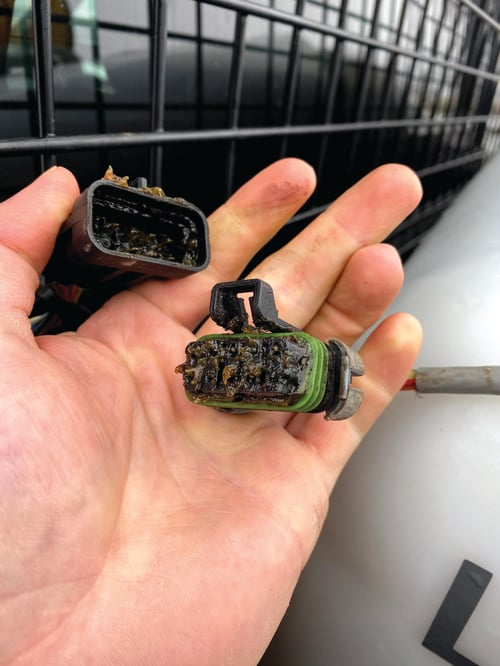
As you disconnect the wiring harness to the controller in the cab of your truck, make sure to apply dielectric grease to the pins and cover the end with a dust cap.
As far as the motor, it’s a good idea to apply oil to the flywheel since this is an area that is most likely to seize up during humid summer weather. If you’re not draining the fuel from the motor, make sure to add a fuel stabilizer to help keep your carburetor from gumming. We like to also spray the outside of the motor with an anti-corrosive such as WD40 to help protect the motor from rust while it sits waiting for the next winter.
Inside storage
Keep your cleaned spray equipment in a shop or garage if space allows. Storing it outside is a fine option, it just allows the elements to take a toll on the equipment. Follow all of these steps at the end of this season and you’ll be ready to run when that first snow sneaks up next season!
Josh Howver, ASM, is production director for Cornerstone Partners Horticultural Services in St. Charles, IL.
Related Articles
Effective strategies for storing deicing liquids
Ice Management
Factors to consider when planning for liquid materials storage.
Maximizing ROI with liquids
Ice Management
Initial liquids costs are high but long-term benefits can be substantial.
5 things to consider before switching to brine
Ice Management
Operations
Five areas to consider before adding brine to your toolbox