
Buying bagged deicer
Because the ice melt industry is largely unregulated, it is critical to look beyond the marketing on the front of the bag and focus on the ingredient label and application rates on the back.
Read the ingredients like food labels
Products manufactured in the USA should list ingredients. Read these like a food label: the ingredient listed first is present in the highest quantity, followed by others in descending order. Look for the CAS# (Chemical Abstracts Service number) to verify the chemical makeup. Products manufactured outside the USA are not held to the same labeling regulations and often do not list ingredients, which can be dangerous for consumers trying to avoid specific chemicals.
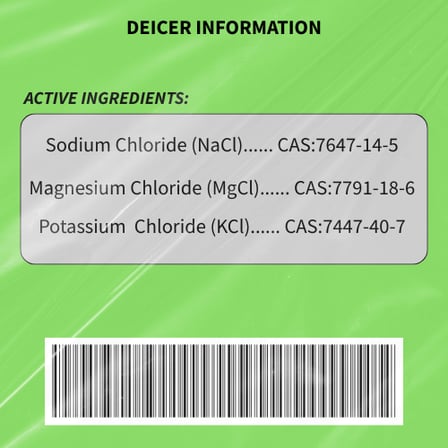 Image: Example of ingredients in bagged product with CAS numbers.
Identify the base ingredient
Ingredients are usually listed in descending order by weight. If Sodium Chloride is listed first, that is the bulk of the product, regardless of how many premium buzzwords appear on the label.
-
Rock salt (Sodium Chloride): The most common and inexpensive option. It is 100% corrosive and effectively stops working when temperatures drop below 18°F.
-
Calcium Chloride: A high-performance option that melts to -65°F. It generates heat (exothermic) for immediate results but leaves a greasy residue and is highly corrosive to concrete rebar and hygroscopic (attracts moisture).
-
Magnesium Chloride: Works to -10°F and is less corrosive than other chlorides, but it is expensive and refreezes quickly, requiring frequent reapplication.
-
Acetates (CMA/NAAC): Environmentally friendly and chloride-free, but extremely expensive and typically found only in tiny amounts within blends.
Tricky label language
Manufacturers often use vague terminology or "blends" to market inexpensive fillers as premium products.
-
“Blends”: These bags usually contain Rock Salt as the primary filler because it is cheap, with only trace amounts of high-performance ingredients (like CMA or Calcium Chloride) added to keep the price down while claiming their benefits.
-
“Pet Friendly" or "Eco-Friendly”: These terms are often marketing ploys used on bags containing aggregates (e.g., sand, dolomite, shale) or fertilizers (i.e., Urea). While they may offer traction, aggregates do not melt ice, and nitrogen-based products (Urea) can still kill vegetation.
-
“Safe for Vegetation”: Products containing Potassium Chloride or Urea are often marketed this way because they are common fertilizer components. However, any ice melt containing nitrogen can kill vegetation if over-applied.
-
“Contains No Salt”: Be wary of this claim. It may technically mean "No Sodium Chloride," but the product could still contain other chlorides or corrosive chemicals. Always verify the CAS.
.png?width=1920&height=1080&name=CONTENT_101_INCIDENT%20REPORTINGBPS_final.pdf%20(3).png)