

Choosing the right platform requires ownership and leadership
Mike McCarron
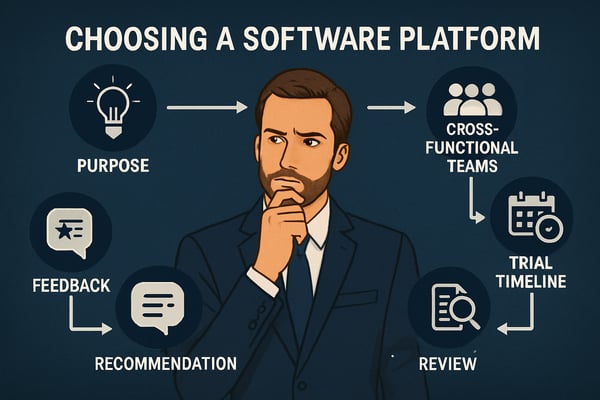
Keys to snow business software selection
In today’s digital-first business landscape, software isn’t just a tool — it’s the backbone of operations, communication and innovation. Whether it’s a CRM platform, project management suite, data analytics engine or customer support system, the software a company chooses can dramatically shape its efficiency, culture and bottom line. That’s why the process of evaluating and test-driving new software is far more than a technical exercise, it’s a strategic mission. And like any mission, it needs a commander. The person owning the software evaluation process won’t always be the tester, as owners are not always good field testers.
Too often, companies approach software trials with casual curiosity or fragmented responsibility. A few team members dabble with demos, feedback is scattered, and decisions are made based on surface-level impressions. The result? Misaligned purchases, underutilized platforms and costly regrets. To truly extract value from software evaluations, you — or better yet, a cross-functional team — must own the process from start to finish. Ownership ensures clarity, accountability and actionable insights that lead to smart, confident decisions.
Software trials are crucial
The explosion of SaaS (Software as a Service) offerings has given businesses access to a dizzying array of tools. From niche startups to enterprise giants, every vendor promises innovation, integration and impact. But with so many options, the risk of choosing poorly has grown exponentially — and the costs have exploded as well. A well-run software trial allows companies to:
-
Validate vendor claims against real-world use cases
-
Assess usability across different roles and departments
-
Test integration with existing systems and workflows
-
Gauge support and responsiveness from the vendor
-
Estimate ROI based on actual performance metrics and real time costs
But none of this happens by accident. It requires structure, intention and leadership.
Owning the process
When no one owns the software trial process, it quickly devolves into chaos. Different departments may test different features; feedback gets lost in email threads; and decisions are made based on anecdotal evidence. Ownership transforms this chaos into clarity. Here’s what ownership looks like in practice:
Defining the purpose and scope. Before any demos are scheduled or trials initiated, the owner must define the “why.” What problem is the company trying to solve? What outcomes are expected? Is the goal to replace an existing tool, augment a process, or explore a new capability? This clarity helps narrow the field of contenders and ensures that the evaluation criteria are aligned with business goals.
Building a cross-functional evaluation team. Software rarely impacts one department. A solid CRM affects sales, marketing and customer service. A project management tool touches product, engineering and operations. That’s why the owner should assemble a team that represents all relevant stakeholders. Each member brings unique perspectives, use cases and priorities. Together, they create a holistic view of the software’s potential impact on the entire company.
Creating a structured evaluation framework. The owner should develop a scorecard/rubric (see table below) that outlines key criteria to help the team decide what’s a benefit and what’s a loss for each tested software or new system.
Managing the trial timeline. Software trials often come with limited windows—14, 30, maybe 60 days. The owner must create a timeline that includes:
-
Kickoff meetings – all teams and divisions represented
-
Hands-on testing periods – true field employees that will use this each day
-
Feedback collection deadlines
-
Final review and recommendation
This timeline keeps the team focused and ensures that the trial doesn’t fizzle out due to competing priorities.
Facilitating feedback and documentation. The owner should provide clear channels for feedback, whether it’s a shared document, survey or dedicated Slack channel. More importantly, they should synthesize this feedback into a cohesive report that highlights strengths, weaknesses and trade-offs. This documentation becomes a valuable asset for decision-makers and a reference point for future evaluations.
Presenting a recommendation. At the end of the trial, the owner should present a clear recommendation: adopt, reject or continue testing. This recommendation should be backed by data, feedback and alignment with strategic goals. Even if the decision is to walk away from all options, the process will have yielded valuable insights and clarified future needs.
Case Study: A tale of two trials
Consider two companies evaluating a new customer support platform.
Company A assigns the trial to a junior IT staffer with no clear mandate. They test a few features, forget to loop in customer service, and decide based on price alone. Six months later, the platform is underused, agents are frustrated, and customer satisfaction drops.
Company B appoints a product manager to lead the trial. She builds a team with reps from IT, customer service and operations. They define success metrics, test integrations and collect structured feedback. The chosen platform is adopted smoothly, and within three months, ticket resolution times improve by 30%.
The difference? Ownership. In a world where software choices shape everything from customer experience to employee productivity, the stakes are too high to leave trials to chance. So, the next time your company considers a new platform, ask the most important question first: Who owns this?
Because when someone owns the process, the company owns the outcome, and many hours of frustration are saved regardless of what you end up choosing.
Mike McCarron is president and founder of Image Works Landscape Management, a commercial landscape maintenance and snow removal firm in the Northern Virginia market. He has 20+ years of industry experience. Email him at mike@imageworkslandscaping.com.
Related Articles

Managing irate snow removal customers
Business
Tips on handling the inevitable cranky snow services client

H-2B in the "ice" age
Business
Visa program can be a viable option for winter operations
Invoices for sale
Business
Factoring is an option to get cash flow moving in a snow removal business.