

Eddy Zakes combines business discipline and people-first leadership to grow Earth Development
Patrick White
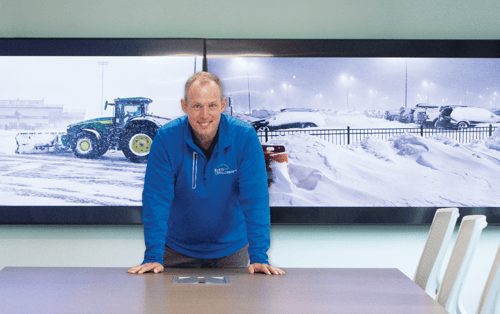
Eddy Zakes combines business discipline and people-first leadership to grow Earth Development
How does someone go from leading an entrepreneurship school in Barcelona, Spain, to running a snow and ice management company in Green Bay, WI? Eddy Zakes, president and CEO of Earth Development, made the transition by doing what he has long advised entrepreneurs to do: Make a plan and follow the numbers.
After five years of living abroad and with children getting to school age, Zakes and his wife, Autumn, decided in 2020 that it was time to return to the United States.
"I knew that I wanted to go back into hands-on entrepreneurship, and decided that this time, instead of starting a business from scratch, I was going to buy a business and then run that business," Zakes explains.
He built a list of criteria: a business that was relatively easy to understand ("I didn't want to try to develop pharmaceutical drugs or virtual reality technology!"); a business that had recurring or heavily repeating revenue; a business that was essential; and a business that had a track record of profitability.
Zakes' search produced a list of about 200 companies for sale in various industries in all parts of the country. After investigating many of them and meeting with several, he zeroed in on Earth Development.
"It checked a lot of my boxes. It wasn't perfect, obviously, because if a business is perfect, it's going to be extraordinarily expensive, or it's not going to be for sale," he says. "But the founder of the company had built it into a successful small business, and I think had reached a level where he felt it was time to transition the ownership. And what I wanted to do was find something that I could help get to the next level, which was part of my passion."
The transaction took place in the heart of the Covid pandemic, largely over Zoom. After hundreds of hours of due diligence and countless conversations with the previous owners, the transaction was finally completed in March 2021. Zakes showed up for work the next day, ready to introduce himself to the company's six employees – and the snow industry.
Introduction to the industry
While the former business school executive was well aware that data and dollar figures are critical, Zakes also understood that it's the people within a company that ultimately determine its success. So he started working from day one to support and develop the Earth Development team. But he understood that the group would be apprehensive initially.
"The person that they had been working for had just sold the business and was no longer in charge. I walked in and said, 'Hi, I'm Eddy. I bought this company because I think it's a great company,' Zakes says. "I'm not a turnaround specialist. I bought it because I think this thing has tremendous potential. And what makes it special is the people who are here.' "
Zakes told the team he had no plans to let anybody go, and that he was looking to build on their success. "And from that point," he says, "we were off to the races."
The company has, indeed, been racing. In the little over five years since Zakes took ownership, Earth Development has seen its annual revenues triple, and it's gone from operating in five states to 15. The six-person team has grown to about 25.
"We've been able to do that by completely changing the scalability of the company, the processes and procedures," Zakes explains. "I think my skill set is building repeatable processes, investing heavily in the culture and the team, and then empowering the team to maximize the potential of what we can do together."
With no generational ownership pedigree behind him, no snow-and-lawn start-up scars to learn from and no experience working for another snow company, Zakes turned to the industry experience of his existing team at Earth Development, along with SIMA, to learn the ropes.
"I was learning as fast as I could, and SIMA has been a significant part of that learning. It has helped me make so many contacts," Zakes says. "I think part of it, too, is I want to be the kind of person who isn't too proud to ask for help. I want to be the person who is quick to introduce myself to others and strike up a conversation."
Zakes earned his Certified Snow Professional (CSP) and Advanced Snow Manager (ASM) credentials through SIMA, and has helped others within the company further their industry knowledge and credentials. For example, Vice President of Operations Matt Hager, one of the employees already on board when Zakes purchased the company, has earned his CSP; Customer Success Manager Cassandra Baron, CSP, ASM, is both the 2023 SIMA Business Professional of the Year and a SIMA Accelerate Emerging Leaders graduate; and Director of Operations Jeremy Avery is in the current Accelerate class.
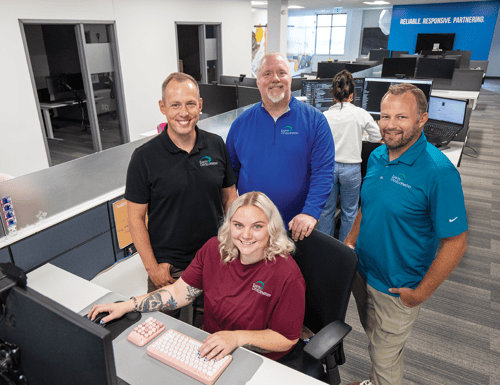
Supporting the experts
Zakes' role as owner looks different than it does at many snow companies. While many in the industry learn the operational ropes first and need to learn the business side of things as they go, the opposite is true for Zakes.
"I have sort of a classical business background," he says. "I parachuted into this industry and have applied myself to learn this trade – getting involved with SIMA, serving on committees, going through the credentialing process. Because it's more than just a business – there's a professionalism and a craftsmanship that we want to represent. I think in order to be authentic, I have to understand those things."
Zakes says as an industry newcomer on the day he walked into the business, every person in the business was technically better at their unique, industry-specific job than he was. "I had to learn how to support an expert as opposed to becoming the expert who did that job," he notes.
One way he has found to support the team is by dramatically changing how the company operates internally. "When you're a very small company, you need generalists. You need people who, if the company needs sales, say, 'I can do sales. I've got this,' " Zakes says. "To make a company scalable long term, you eventually need more and more specialists. So we have had to develop people to be leaders within an organization."
Zakes says he's proud of the diversity of the group that he's assembled since taking over – melding industry expertise with those who have no snow and ice experience, but have expertise in niche business aspects, whether it's sales or marketing or accounting.
He's also focused on using his business expertise to help others develop their skills. For example, Earth Development has supported team members who've gone back to college by setting them up with flexible schedules to facilitate that.
"We built the Earth Development Academy, a 12-month cohort-based learning program that we can run as needed to help what we call our Next-Level Leaders advance to the next stage of their careers," Zakes adds. "Plus, every year we host our Earth Development Summer and Winter Summit, where all of our staff, including our fully remote staff, come to Green Bay to be together as a team. We really value both the time as a team and make the development and training of our team a priority."
The effort toward personnel development shows. Earth Development has been named a Best Place to Work for five years by SIMA.
"We're very proud of that," Zakes says. "And there's a component of marketing and recruiting, as well. We believe that great team members have tremendous agency. They don't have to work at Earth Development. They choose to work at Earth Development."
Since taking ownership, Zakes says he has made it a priority to introduce a company culture that persistently pursues perfection, that's fair and generous, and that is passionate about its people. Those are values that resonate with both employees and clients, he stresses. "Top performers want to be around top performers – they don't put up with BS," Zakes says.
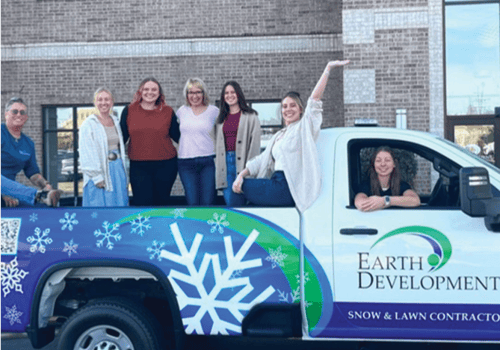
Consistency, repeatability
Zakes intentionally searched for a business with repeatable income. He says ensuring repeatable income requires performing repeatably excellent work.
With independent service partners serving clients across 15 states, much of the company training is focused on consistency.
Zakes uses the analogy that when you order your favorite Starbucks drink in one state, it tastes exactly the way it would in another state. He wants to be sure Earth Development is overseeing the same quality work regardless of the client's location.
That largely falls to the company's Field Operations Supervisors, who are hired in various locations to oversee the work being done by the independent service partners. The supervisors often have deep industry experience and some crew management experience but may be looking to transition into a non-field role that still has them outside, active and engaged.
"It's a little bit like being a coach," Zakes says. "Most of the job is helping our service partners perform at their best by communicating clearly, setting expectations, and providing support. But a good coach also holds people accountable when standards aren't being met. We hire slowly because finding people who can balance partnership and accountability is critical."
Again, the goal is to train Field Operations Supervisors to oversee consistent results company-wide. "All of the companies in our industry are buying trucks and plows and salters from the same handful of companies. At the end of the day, the only thing that truly separates us from everybody else is the quality of the people that are working here, their devotion to their craft and their desire to do it with excellence," Zakes says.
Earth development takes "anti-broker" tack with its business model
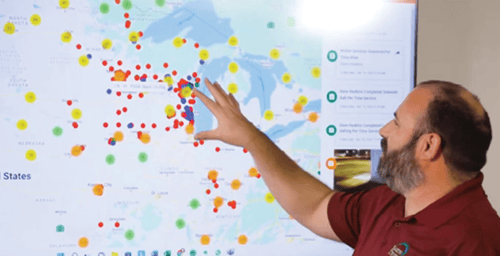
"I know the topic of aggregators or brokers can be sensitive within the snow and ice community, and I think for good reason," acknowledges Eddy Zakes, CSP, ASM, president and CEO of Earth Development, which relies almost exclusively on the aggregator model to provide services to clients. "I think that sometimes aggregators have a bad reputation that has been deserved, because there are some bad actors who very wittingly are preying on contractors – trying to find basically a sucker who will take any job and sign the contract and become obligated to fulfill a scope of work for the cheapest amount possible."
Zakes says he and his team have made a conscious effort "to be the anti-national subcontracting organization." Instead of simply hiring subcontractors, the company seeks to build long-term relationships with "service partners" to help the independent contractors grow their own businesses.
"We want to be known as being radically different," Zakes says. "We want to make sure that the amount that we're paying our service partners is enough for them to be able to do exceptional work, feed their families and want to continue working with us."
Zakes cites one service partner who started by handling one or two properties representing about $6,000 of work a year, and who now is approaching $1.2 million of work annually for Earth Development.
"We take tremendous pride in supporting that owner and his team to be able to get access to sites that they otherwise may not be able to get access to on their own, and so then we're becoming a form of outsourced sales and marketing for them," Zakes says. "They provide services as independent companies – they're driving their trucks with their companies' names on them."
Win-win relationship
Zakes says many snow and ice companies excel in operations but may not be exceptional at sales. Other companies may not be large enough to have access to clients and sites that will help them grow. And others don't have the internal back-office capabilities to keep up on invoicing and collecting payments. These are exactly the areas where Earth Development excels, he says.
Furthermore, there's protection built in for the service providers. It's not uncommon in the industry that if a client doesn't pay the aggregator, the subcontractor doesn't get paid either. But Earth Development is adamant that its service partners will get paid regardless, on 30-day terms, even if the client takes longer to pay or never pays at all.
"We have had some service partners now for more than 20 years, and I think that says something about the fact that it's truly a partnership," Zakes says. "When they do great work, they enhance Earth Development's ability to win more work. And then if they're doing good work, we're going to sub that additional work to them, so it's a full virtuous cycle."
Patrick White has covered the landscape and snow and ice management industries for a variety of magazines for over 25 years. He is based in Vermont. Contact him at pwhite@meadowridgemedia.com.
Related Articles

The power of listening & acting
Business
Establishing a culture of communication adds a layer of value that can take you to the next level.

Managing your snow team under pressure
Business
Keep people, performance, and trust intact when everything is on the line

Eyes on the prize
Business
Assemble a comprehensive team to analyze financials and make informed decisions.