

Kevin Mahon, CSP
Consider climate, storm type and snow-to-liquid ratio every time you make a salting strategy
Brine is a great tool, but it shouldn’t be your only tool. In the last few years, the industry has heavily invested in liquids, which is a big win for both contractors and customers. Liquids are a great way to control where salt is applied and they quickly create a barrier to protect surfaces. They also are a way to reduce your salt usage; but depending on the storm, you may be better off spreading granular salt.
Water below 32˚F is dangerous. While effective in stopping ice from bonding to surfaces, the main goal of a salt application is to keep winter precipitation in a liquid state and to reduce its freezing point below ambient temperature. This allows water to evaporate so surfaces can eventually dry out. Both granular and brine can do these things, so does it matter which one you choose?
To use a medical term, a “contraindication” is a condition that makes a particular treatment or procedure inadvisable. Just like there are situations where sodium chloride won’t work well, there are also situations where a liquid application won’t work well. A few conditions to consider every time you make a salting strategy are climate, storm type and the snow-to-liquid ratio. Not all snow is the same, so your salt applications shouldn’t be, either.
Climate
Developing an effective salting strategy requires a comprehensive understanding of your climate, encompassing not only your geographical region but also the factors that influence how precipitation interacts with surfaces.
Rob Reale, director of meteorological services at WeatherWorks, emphasizes that the weather norms of a specific region do not guarantee consistent storm systems. Seasonal shifts in temperature, patterns, and sun angle alter the characteristics of snow. For example, October in the Upper Midwest can resemble December in the mid-Atlantic — both exhibiting fluctuating temperatures and mixed precipitation.
Even within a single state, microclimates can exist. Rob noted that northern New Mexico has a snow-to-liquid ratio comparable to Minneapolis, MN. Therefore, it’s crucial to reconsider the notion that you can get away with a single salt strategy for an entire winter in your region.
Storm types
The second thing to consider as you prepare your strategy for an upcoming event is to know the storm system you will be dealing with. Is the storm coming from a cold, dry place, like with a clipper, or is it coming from a warm, wet place, as with a coastal storm? Relative humidity and dew point are very important when it comes to snow, so remember that warmer air can hold more moisture than cooler air.
Origin alone will not provide a complete picture. Storm systems travel long distances and confront different temperatures at various altitudes. Where and when moisture begins to fall, along with surface elevation, will determine how that precipitation will land.
The difference between a few hundred feet in elevation or even just a few miles geographically can create various outcomes. As systems enter a region and battle against fluctuating temperatures you can also see different precipitation types in just a few short minutes’ time. I have seen storms start as snow, change over to rain and then back to snow. I have arrived at the entry to a site where it was raining and driven up the hill to the campus where it was snowing. I have had sites get 10” of snow while sites 20 miles north and south get less than 1”. The longer you stay in this industry, the more you will learn that no two storms are alike.
Snow-to-liquid ratio
Access to good meteorological models and briefings is so important to our industry, because so many factors need to be considered when forecasting the snow-to-liquid ratio.
Not all snow is created equal. Have you sometimes used a backpack blower to clear snow off a sidewalk and other times needed a shovel to clear sleet off a sidewalk? I’m sure you said “yes” to both questions, and I’m also sure you have a preference as to which one you would rather do again.
Average Snow-to-liquid Ratios per temperature:
32°F / 0°C = 8-1
30°F / -1.11°C = 10-1
20°F / -6.66°C = 15-1
15°F / -9.44°C = 20-1
The snow-to-liquid ratio is a measurement of how many inches of snow you will get out of one inch of rain. To continue with the example, sleet has a lot of water and is typically at a ratio of 3-1, while very cold and fluffy snow has much less water and could be as high as a 40-1 ratio. Most snow falls between a 6-1 and 20-1 ratio.
This is important because wetter snow eats more salt. Would you use the same amount of salt to melt an ice cube as you would to melt a block of ice? The more frozen water, the more salt that is needed and this applies to snow in the same way. Temperature will also play a role. As an example, sodium chloride is five times more effective at 30˚F than it is at 20˚F.
Salt strategy
Once you know the factors that influence an event, you can put them together to create a storm-specific strategy. To fight precipitation effectively, we need to know: how much water there is, the ground and air temperatures, and the exact date and time (which tells us what kind of precipitation to expect). We also need to see if sunlight will help and if existing snowpack will keep the ground cold. Now we need to decide the type of salt application that would work best to quickly provide safe surfaces for our clients.
Brine or granular
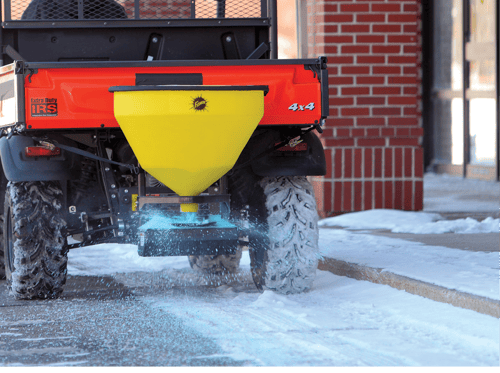
Water can only hold so much salt. After hitting its saturation point, any additional salt will just settle to the bottom. Typical brine applications end up putting around 175 pounds per acre of salt on your surfaces. For wetter snow events, you might apply between 300-800 pounds per acre (depending on salt type). Brine is already in a liquid state, which means that applications during mixed-precipitation events will lead to quicker dilution and runoff compared to granular applications.
When rain, freezing rain, sleet and/or heavy snow is forecasted, you will need more salt to fight the increased water content. Colder temperatures also need higher application rates for the same efficacy. It may be hard to have a big enough brine tank during these events to sufficiently increase the application rates without refills during the route. In addition, rain and freezing rain can wash off brine that has not dried on surfaces, making applications during these conditions ineffective.
A couple examples of when using granular salt will be a safer decision:
- If you need to do an anti-icing application (pre-treatment) but the incoming system will be starting as rain.
- If you need to do a deicing application (post-treatment) when the system will be changing to freezing rain.
- A warm-originated storm that will produce heavy snow and it will be closer to 20˚F, meaning a higher application rate is needed.
These are a few reasons why you might not want to be a purely liquid service provider.

Keep your options open
For many events, no matter where you work, brine is a wonderful option. This is especially true in cold climates that stay around or below freezing for a large part of the operations season, because these areas usually see colder and drier storms with lower accumulations. That means the lower application rates of brine will suffice because there are fewer mixed precipitation events to fight and higher snow ratios with lighter snow.
Warmer regions that see fluctuating temperatures even during the depths of winter might want to keep their options open. These regions will see heavier snow ratios and more mixed-precipitation events. But remember, even those in colder climates will see the effects of seasonal change in late autumn and early spring.
A big reason for the investment in brine is to save money and reduce salt usage. Another way to accomplish this is to calibrate your equipment, know proper application rates for different conditions and train your employees. Sending Chuck out in the truck to “beach the lot” is not using industry standards. “Salt it until you see it” is not a specific rate. Driving around after storms and seeing residual salt piles everywhere is evidence that there are those in the industry not being wise by their customers, the environment or even their own wallet.
There are great options for calibrated granular spreaders for trucks and sidewalk equipment. There’s even technology that can restrict operators and run reports for managers. Continue to invest in good equipment while educating yourself and your team to make sure you have all the options needed to protect life, property and production in any storm. Our communities depend on us.
Common storm systems
Every storm is different, but knowing a system’s origin and how the jet stream will affect the track can give you a good idea of what to expect:
Central North America
Clippers are fast-moving, low-pressure systems that flow with the polar jet stream across the Great Plains and usually do not produce an excessive amount of snow. They traditionally form out of the Canadian province of Alberta. They often are accompanied by strong winds, which is why the Northern Plains are known as “Blizzard Alley.” Occasionally, clippers can survive long enough to reach the East Coast.
Eastern North America
Coastal storms and Inland Runners are influenced by the subtropical jet stream and have origins in warm, wet air. These low-pressure systems can take different routes and dump snow as soon as they find cold air. This can be as far south as New Orleans, as we saw this past winter, or as far north as the Canadian Maritimes. They can track east to the Atlantic and become a coastal storm or track northwest and become an Inland Runner that can even hit the Midwest. Because of their warm origins, they have the capability to dump heavy and quickly accumulating snow. Nor’easters happen when these systems restrengthen after finding the Atlantic Ocean.
Western North America
The Pacific Ocean provides the moisture for West Coast storms. The way that low-pressure systems interact with the jet stream and then navigate over the different ranges of the Rocky Mountains affect the outcome of these snowstorms. Atmospheric rivers, like the famous “Pineapple Express,” can become fast lanes for warm, wet air out in the ocean to quickly flow onto land. As it moves up cold mountains, it can dump lots of snow for long durations. Thanks to orographic lift, most snow on the inland mountains is fluffy and is what makes places like Utah and Colorado popular ski destinations.
Kevin Mahon, CSP, has been in the snow industry for 23 years and is Director of Operations at Vault Enterprises in New Jersey. Contact him at KMahon@vault-enterprises.com.

.jpg?width=463&height=301&name=047-01%20(2).jpg)
.jpg?width=1000&height=671&name=Content100_AllenBuildersCover%20(1).jpg)